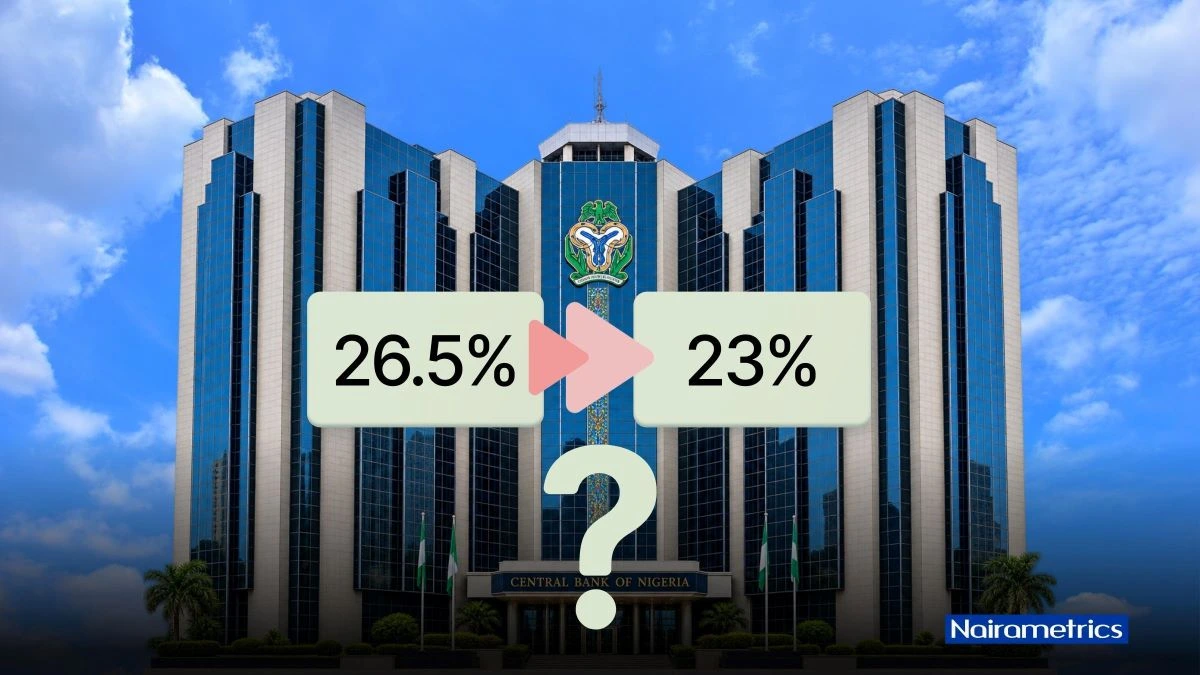
The Central Bank of Nigeria has reduced the Monetary Policy Rate by 350 basis points to 23% from 26.5%, the first change since February, following the 307th Monetary Policy Committee meeting on September 22, 2026. The decision marks a decisive turn in the domestic interest-rate cycle and carries direct consequences for bond, mutual fund and pension fund portfolios.
Treasury bill yields were already easing before the policy move. At the September 9 auction, the 364-day stop rate dropped to 16.62% from 16.84% on September 2 and 17.59% on August 12, a decline of 97 basis points in under a month and the third consecutive cut in the one-year rate. Investors bid N2.64 trillion against N750 billion offered, with the 364-day instrument accounting for 96% of subscriptions; the CBN ultimately allotted N1.054 trillion.
Money-market funds, which hold significant Treasury bills, commercial papers and other short-duration securities, are most exposed to the shift. Funds already holding higher-yielding instruments can continue earning contracted returns until maturity, but reinvestment will occur at lower prevailing rates.
Longer-dated FGN bond holdings may benefit from price appreciation because bond prices move inversely to yields. At the September 14 auction, the new 16.79% FGN September 2036 bond cleared at a marginal rate of 16.79%, while the reopened 15.45% FGN June 2038 bond cleared at 16.85%, below the 17.79% recorded in August.
Equities become relatively more attractive as fixed-income yields moderate. The NGX All-Share Index rose 2.78% in the week ended September 18 to a year-to-date return of 60.53%, then crossed the 250,000-point mark on September 21 with a year-to-date gain of 60.76%. Equity fund net asset value, however, dipped from N241.38 billion in July to N230.50 billion in August, illustrating volatility.
Pension portfolios face a broader repositioning. PenCom data show about N17.40 trillion of pension assets were invested in FGN securities as of June 2026. Falling yields support the market value of existing bonds but create reinvestment challenges as securities mature.
Samuel Oyekanmi, Head of Research and Insights at Norrenberger, said pressure on Treasury bill yields could intensify if the easing cycle continues, moderating returns on new fixed-income investments while longer-dated bond holdings cushion the impact. Nathanael Disu, Equity Research Analyst at Afrinvest, described the cut as welcome for equities and cited Nigeria's inclusion in the FTSE Russell Frontier Market Index as another potential driver of flows. Kehinde Jones, Head of Research and Strategy at Anchoria Capital Group, noted the CBN called the move a "reset," with inflation at 15.39% in August 2026 and real GDP growth at 4.43% in the second quarter. He said lower borrowing costs could support consumer, industrial and oil and gas earnings if transmission to lending rates is quick, and that the latest Open Market Operations auction cleared at 18.41%.