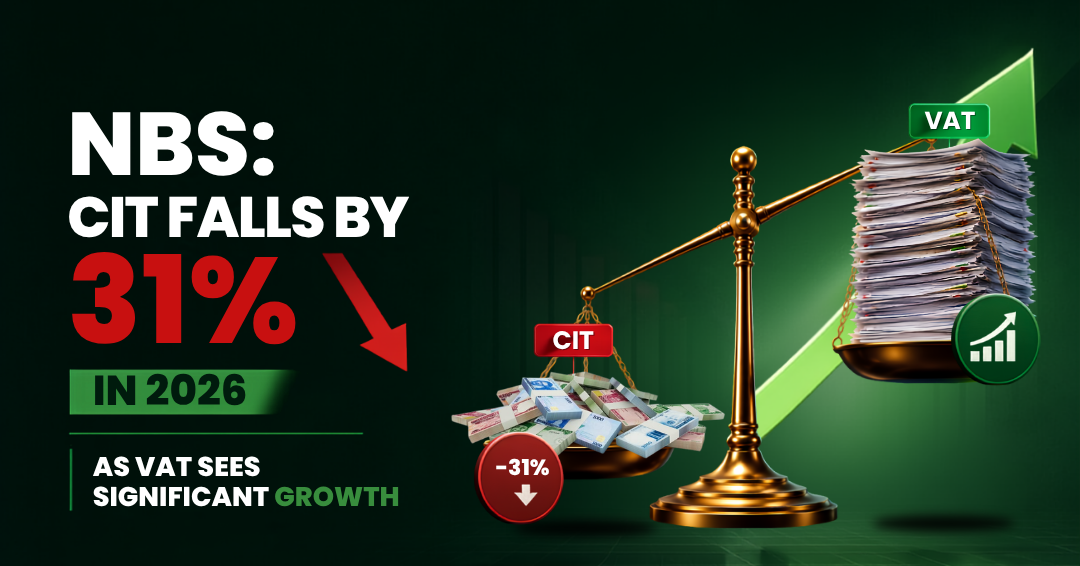
Company Income Tax collections in Nigeria contracted sharply during the first quarter of 2026, according to newly published figures from the National Bureau of Statistics. The official Q1 2026 CIT Report, released in Abuja, shows that corporate tax revenue fell to N1.37 trillion, representing a 31% year-on-year decline from the N1.98 trillion recorded in the corresponding quarter of 2025.
The steep drop has drawn attention from financial analysts, who describe the numbers as a reflection of the punishing domestic operating climate confronting Nigerian businesses. Enterprises are contending with a combination of elevated borrowing costs, unstable foreign exchange rates, and costly energy inputs, all of which are steadily eroding profitability.
The data reveals a striking contrast when placed alongside consumption tax performance. Value-Added Tax collections for the same period rose by 17.06%, climbing from N2.06 trillion in Q1 2025 to N2.42 trillion in Q1 2026.
Opeyemi Ajetunmobi, Head of Advisory and Research at a Lagos-based investment firm, observed that the opposing trajectories of CIT and VAT paint a telling picture. While consumer spending and broader economic activity remain relatively resilient, businesses are struggling to convert transaction volumes into bottom-line earnings amid persistently unstable economic indicators.
Bolanle Daniel Utere, a Finance Director at a Free Trade Zone, reinforced this interpretation. Utere stated that the slump in CIT inflows is the mathematical consequence of eroded corporate profits rather than a sign of a stagnant economy. She highlighted that sustained inflationary pressures coupled with mounting operational expenses are squeezing profit margins across sectors, leaving many companies operating in a high-turnover but low-profit environment that ultimately deprives the federation account of critical corporate tax revenue.
The divergence between direct and indirect tax performance raises significant questions for fiscal policymakers. With CIT constituting a major component of federally collected revenue, a prolonged downturn in corporate profitability could complicate budget implementation and widen fiscal deficits, even as VAT receipts provide a partial cushion.