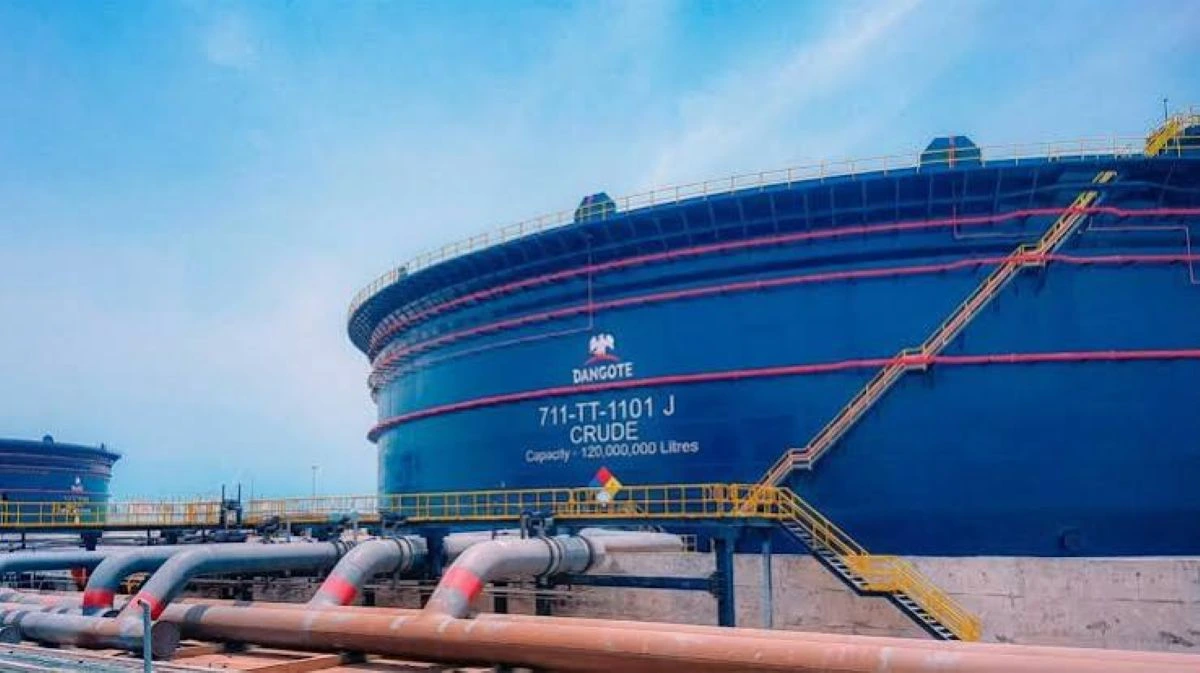
The Dangote Petroleum Refinery supplied approximately 50 million litres of petrol daily to Nigeria’s domestic market in the first half of 2026, according to the Dangote Group’s macroeconomic report for the period. The report, titled Between Windfall and Inflation and prepared by the group’s Economic Research and Intelligence Unit, attributes the milestone to expanded production and rising exports.
Daily petrol supply peaked at a record 56 million litres in April, against a planned evacuation of roughly 1.1 million tonnes per month. The refinery’s capacity utilisation climbed from about 45 percent in early 2025 to between 98 percent and 101 percent from April to June 2026. Its processing capacity was also rerated from 650,000 to 700,000 barrels per day in June.
The report stated: “By the first half of 2026 the plant was supplying on the order of 50 million litres of petrol a day to the domestic market (a record 56 million litres a day in April, against a planned evacuation of about 1.1 million tonnes a month), alongside some 25 million litres a day of diesel and up to 29 million litres a day of jet fuel and exporting a growing surplus of refined product across West Africa and beyond.”
The higher output enabled the facility to meet a substantial portion of Nigeria’s domestic petroleum demand while expanding exports of diesel, aviation fuel and other refined products. Nigeria’s refined petroleum product exports increased by 51 percent year-on-year in the first quarter of 2026.
Data from the Nigerian Midstream and Downstream Petroleum Regulatory Authority show that average daily petrol imports declined by 26 percent to 14.6 million litres in August 2026, from 19.7 million litres in July. In the same month, Dangote Refinery recorded average capacity utilisation of 105.21 percent, producing 41.94 million litres of petrol, 18.01 million litres of diesel and 24.48 million litres of aviation fuel daily. Domestic petrol receipts averaged 35.87 million litres per day, exports stood at 9.73 million litres, and closing stock reached 360.4 million litres. For diesel, daily domestic receipts stood at 12.37 million litres against exports of 8.75 million litres, while aviation fuel exports averaged 21.30 million litres daily compared with domestic receipts of 3.07 million litres.
Figures from the National Bureau of Statistics indicate that Nigeria’s petrol import bill fell by 96.15 percent to N87.40 billion in Q1 2026, from N2.27 trillion in the corresponding period of 2025.