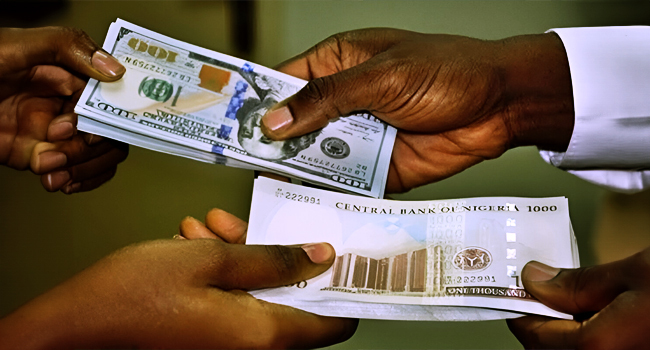
The naira recorded its strongest performance in nearly two months on Monday, closing at N1,356/$ at the Nigerian Autonomous Foreign Exchange Market (NAFEM), according to data from the Central Bank of Nigeria (CBN).
The rate represents an appreciation of N9.4 from Friday's close of N1,365.4/$. It is the best closing level since April 23, 2026, when the currency settled at N1,355/$.
Intraday trading on Monday ranged between N1,354.5/$ and N1,360/$, with the simple average exchange rate for the session settling at N1,356.53/$.
The naira's gain coincided with a weaker US dollar in international markets. The US Dollar Index traded around 99.66, remaining near 10-day lows, following reports of a peace agreement aimed at ending the Middle East conflict. The euro hovered near a recent high at $1.159, while sterling traded at about $1.3413.
Analysts say easing geopolitical tensions have improved global risk appetite, reducing demand for safe-haven assets such as the US dollar and providing support for emerging market currencies.
Nigeria's external reserves stood at $50.51 billion as of June 11, 2026, providing a stronger buffer for the foreign exchange market. The CBN has projected that reserves will rise further to $51.04 billion by the end of 2026, up from $45.01 billion in 2025.
The naira's recent performance comes against the backdrop of ongoing monetary and foreign exchange reforms by the CBN aimed at improving market transparency and liquidity. Earlier in February 2026, Nigeria's external reserves climbed to $50.45 billion, their highest level in over a decade, which the CBN attributed to improved forex inflows and policy reforms.
A stable exchange rate environment is expected to support business planning and help moderate imported inflation, providing some relief for Nigerian businesses that rely on imported inputs. The CBN has maintained that its reform agenda will continue to enhance investor confidence and reduce volatility in the official market.