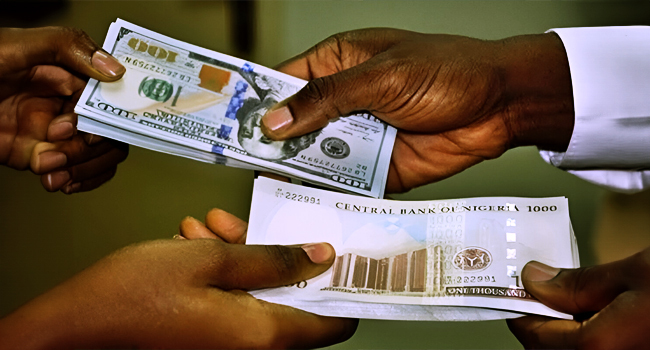
The naira has come under renewed pressure at the official foreign exchange market, closing at **N1,373/$** on June 23 — its weakest level in four weeks — according to data published on the Central Bank of Nigeria's website.
The latest close represents a sustained depreciation since mid-June. The currency traded at N1,356/$ on June 15 before weakening steadily: N1,361.5/$ on June 17, N1,365.5/$ on June 18, N1,371.5/$ on June 19, and N1,369/$ on June 22 before slipping further on June 23.
The current rate is just N1 above the **N1,374/$** recorded on May 26, which stands as the weakest official-market close in recent weeks.
**Global dollar strength drives pressure**
The naira's decline coincides with a broader rally in the U.S. dollar, as markets price in the likelihood that the Federal Reserve will maintain a hawkish monetary policy stance. The U.S. Dollar Index rose 0.38% to **101.39**, its highest level since May 2025.
Chicago Federal Reserve President Austan Goolsbee stated that policymakers remain focused on inflation risks despite a stable labour market. The euro weakened to around $1.138, its lowest level in over a year, while the Japanese yen traded near 161.55 per dollar, close to levels that have previously triggered intervention concerns in Tokyo.
Financial economist Mallam Muftau Yusuf of Kwik Securities Ltd noted that a stronger dollar environment typically creates challenges for emerging and frontier market currencies. "When global investors move toward dollar-denominated assets because of higher U.S. yields, emerging market currencies tend to face pressure. Nigeria is not insulated from these global developments," he said.
**Reserves position improves**
The depreciation comes despite a significant improvement in Nigeria's external reserve position. Foreign reserves recently rose above **$51 billion**, reaching their highest level since 2009, supported by stronger foreign exchange inflows. The CBN had projected that reserves would rise to about $51.04 billion during 2026, anchored on stronger oil earnings, foreign exchange market reforms, and improved external capital inflows.