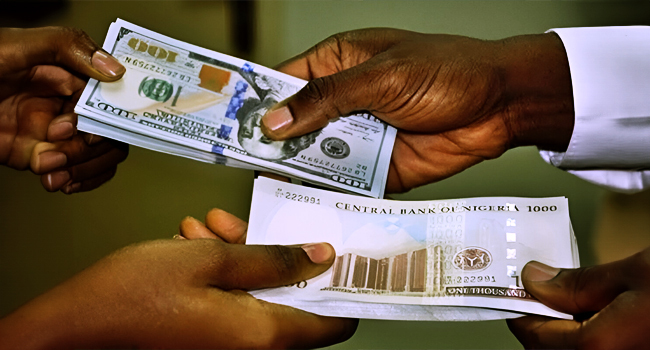
The naira suffered its sharpest single-day depreciation since April, closing at N1,389 per dollar at the official Nigerian Foreign Exchange Market on June 24, 2026.
Data from the Central Bank of Nigeria shows the currency weakened by N16 from the N1,373 rate recorded on June 23. The decline pushed the naira to its weakest closing level since April 7, when it also settled at N1,389 per dollar. During the session, the currency traded within a range of N1,368 to N1,392, with a weighted average rate of N1,380.08 and a simple average of N1,380.46 per dollar.
Interbank turnover edged higher to $125.59 million from $125.31 million in the previous session, while the number of deals rose to 126, up from 106.
The sell-off was driven largely by external forces. The U.S. dollar index, which measures the greenback against six major currencies, climbed to a 13-month high of 101.8. The dollar strengthened to $1.1325 against the euro — its strongest in 13 months — and traded at 161.73 yen, near levels not seen in more than four decades. The rally pushed gold below $4,000 per ounce for the first time in over seven months, while bitcoin briefly dipped under $60,000 for the first time since 2024.
"When global investors move toward dollar-denominated assets because of higher U.S. yields, emerging market currencies tend to face pressure. Nigeria is not insulated from these global developments," Mallam Muftau Yusuf, financial economist at Kwik Securities Ltd, told Nairametrics.
The naira had traded within a relatively tight band of N1,356 to N1,375 for much of June, after strengthening to N1,348.10 per dollar on April 22 — one of its strongest levels this year. It subsequently weakened to N1,383 on April 28 before stabilising through May and early June.
The latest leg of depreciation comes despite a notable improvement in Nigeria's external reserves position. Nigeria's foreign reserves recently surpassed $51 billion, their highest level since 2009, after gaining more than $1 billion in the first half of June alone.
The CBN has maintained a relatively stable exchange rate framework in recent months through ongoing market reforms and improved liquidity conditions, and had projected a stronger reserves position for 2026 supported by improvements in the country's external sector.