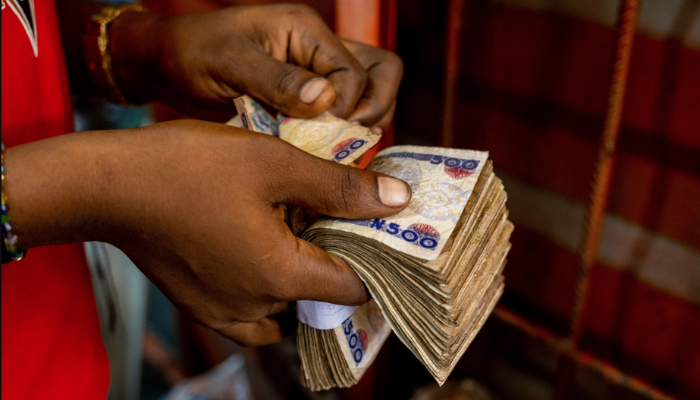
Cash outside Nigeria's banking system rose to N5.19 trillion in May 2026, according to the latest Money and Credit Statistics from the Central Bank of Nigeria (CBN), underscoring the durability of physical cash in an economy that has invested heavily in digital payments infrastructure.
The May figure represents an increase of N109.34 billion or 2.15% from the N5.08 trillion recorded in April 2026. Year-on-year, currency outside banks grew by N559.16 billion or 12.07% from N4.63 trillion in May 2025.
Total currency in circulation stood at N5.69 trillion in May, up from N5.65 trillion in April — a month-on-month rise of N43.59 billion or 0.77%. Annual growth in total currency reached N675.19 billion or 13.46%.
A critical detail for tax planners and compliance professionals is the share of cash that remains outside formal financial channels. Currency held outside banks accounted for 91.27% of all naira in circulation in May, up from 90.03% in April. This means more than N9 of every N10 printed by the central bank is held by households, informal sector operators, and businesses rather than deposited in banks. The ratio remains slightly below the 92.40% recorded in May 2025.
The persistence of cash-dominated transactions poses challenges for tax authorities, including the Federal Inland Revenue Service (FIRS) and state revenue services, as cash transactions are inherently harder to trace, verify, and tax. A large informal economy reduces the effectiveness of withholding tax regimes, VAT collections, and income tax assessments that depend on bank records.
Meanwhile, bank reserves held with the CBN declined from N34.603 trillion in April to N33.763 trillion in May — a drop of N840.77 billion or 2.43%. Despite the monthly decline, reserves remained N2.90 trillion higher year-on-year, representing annual growth of 9.39%.
At the launch of the Nigeria Payment System Vision (PSV) 2028 in Abuja, CBN Governor Olayemi Cardoso said the new framework aims to reduce cash outside the banking system to below 40% of total currency in circulation. The plan envisions deploying more than 10 million QR-code and tap-to-pay acceptance points across markets, transport hubs, rural communities, and commercial centres nationwide.