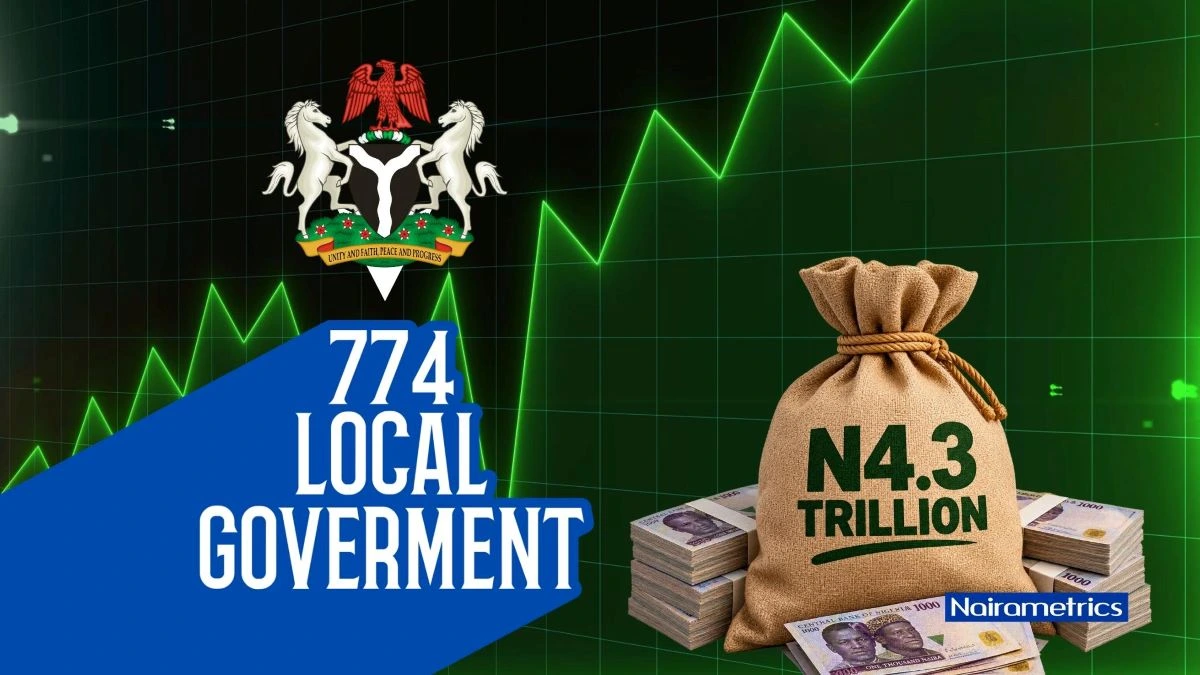
Nigeria's 774 local government areas drew net allocations of N4.3 trillion from the Federation Account in the first eight months of 2026, figures compiled by Nairalytics, the research unit of Nairametrics, show.
On an annualised basis, disbursements to councils are on course to reach N6.5 trillion for the full year, representing a 22.7% increase over the N5.3 trillion recorded in 2025. The trajectory also means allocations have more than tripled relative to pre-reform levels. In 2022, the councils received N2.01 trillion net; the amount climbed to N3.76 trillion in 2023 after the removal of petrol subsidies and the unification of exchange rates expanded the naira value of federation revenue.
An oil market trading near $100 per barrel has further swollen receipts shared among the federal, state and local tiers.
Lagos State accounted for the largest share of the distribution. Its 20 councils received a combined N404.7 billion over the eight-month period, equivalent to 9.3% of total net allocations. All 20 Lagos LGAs ranked among the top 20 recipients nationwide. In 2022, Lagos councils received N146.39 billion, or 7.2% of total payments, with 18 of the top 20 recipients located in the state and the remaining two in Abuja.
The pattern reflects the FAAC sharing framework, which weights population, revenue-generating capacity, terrain and other factors. Allocations to states and LGAs are distributed using equal distribution (40%), population (30%), landmass and terrain (10%), internal revenue generation (10%), and social development indicators spanning education, health and water (10%). With an estimated population above 13 million and strong IGR capacity, Lagos LGAs are structurally positioned to receive the largest slice.
Oversight is also being tightened. The President's approval announced on 28 October 2026 brings the EFCC into monitoring the release, movement and utilisation of FAAC funds, with particular attention to suspected diversion, questionable contracts, ghost workers and other financial irregularities. The commission is expected to coordinate with the Office of the Accountant-General of the Federation, the Ministry of Finance, the Central Bank of Nigeria and the ICPC.
Proposed measures include tracking allocations from source to destination, verifying projects financed with public funds, investigating citizens' complaints and publishing periodic compliance reports.