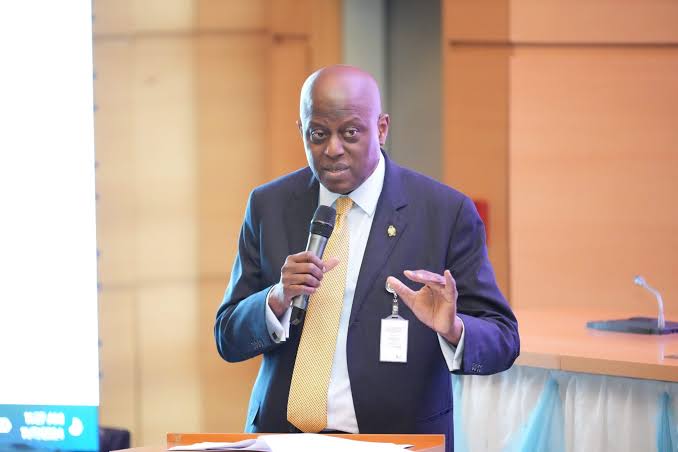
Central Bank of Nigeria (CBN) Governor Olayemi Cardoso has stated that the country's foreign exchange reserves now serve as a cushion against global economic turbulence, protecting households from external pressures.
Speaking at the IMF–World Bank Annual Meetings in Bangkok, Cardoso pointed to rising external reserves, a stable exchange rate and lower inflation as policy outcomes that directly affect ordinary Nigerians.
Nigeria's gross external reserves reached $55.1 billion as of October 13, 2026, a level the governor described as the highest in 18 years.
Cardoso noted he is often asked how the CBN's policy achievements translate into tangible benefits for ordinary Nigerians. He argued that without the stronger buffer, Nigeria would have faced the same headwinds affecting other countries, and possibly more severely.
"What we've been able to accomplish in terms of having very robust external reserves, highest in 18 years, is also something that affects the ordinary person," he said. "Without that, a lot of the headwinds that other countries face, we would be facing them, in fact, in a perhaps worse way than they are facing."
He said Nigeria introduced reforms and policies early enough to strengthen its capacity to withstand external shocks, including pressures linked to the war and discussions around tariffs.
On the exchange rate, Cardoso said the naira had remained relatively stable and had appreciated, with direct and indirect effects across the economy.
"Our exchange rate has held stable, in fact, has appreciated, as a result of which it has a direct effect, or indirect effect on everybody," he said.
He rejected the suggestion that ordinary Nigerians were not benefiting from economic policy gains, insisting that the absence of stronger reserves and exchange rate stability would have exposed them to more severe negative outcomes.