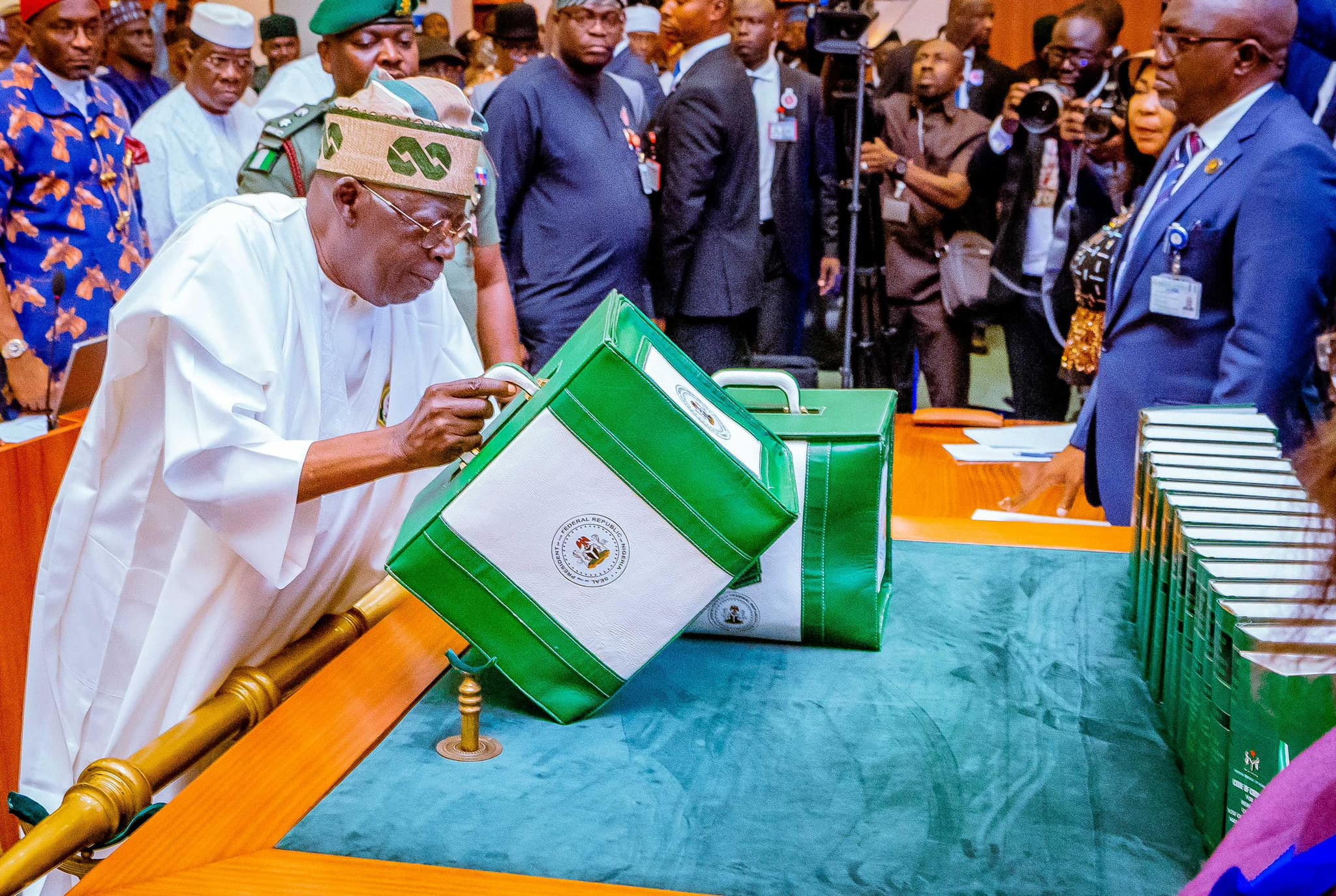
President Bola Tinubu signed the 2026 Appropriation Act into law on 17 April 2026, the largest federal budget in the country's history at N68.32 trillion ($48.80 billion). The State House statement broke down spending into statutory transfers of N4.799 trillion, debt service of N15.8 trillion, recurrent expenditure of N15.4 trillion and capital expenditure of N32.2 trillion. It did not, however, disclose the deficit, the measure that reveals whether government is operating within its means.
The Fiscal Responsibility Act 2007 caps the deficit at 3% of GDP. With projected revenue of N36.87 trillion ($26.34 billion), the shortfall against N68.32 trillion is N31.45 trillion ($22.46 billion), equal to 6.41% of GDP, more than twice the statutory ceiling.
Three deficit figures are now in circulation for the same financial year: N31.45 trillion (6.41%) from BudgIT, N23.85 trillion (4.28%) from a reading of the original presidential proposal, and N25.91 trillion at bill stage in February. The gap reflects differences between the bill and the Act, the treatment of government-owned enterprises, and the GDP denominator. Even the lowest estimate breaches the 3% limit by a third, yet no single figure has enough authority to make the violation one that officials must defend.
The budget also expanded during the legislative process. The President presented ₦58.18 trillion ($41.56 billion), while the Act he signed totalled ₦68.32 trillion, an addition of N10.14 trillion, or about 17.4%. BudgIT identified roughly N6.93 trillion across 11,122 questionable line items inserted during consideration.
On oil, the price assumption of $64.85 a barrel turned out to be conservative, as Brent traded near $104 on 25 September. The strain came from output. The budget assumed 1.84 million barrels a day, but production stood at 1.678 million barrels in August and missed targets from May through August. First-half output of 294.6 million barrels was 38.4 million below the 333.0 million budgeted, worth about $2.49 billion at the assumed price.
Revenue performance echoed the shortfall. First-quarter tax collections came in N2.24 trillion below target, and although gross FAAC receipts for H1 tracked the annual projection, gross figures overstate distributable revenue.
The debt outlook is severe. The IMF estimates interest payments will absorb 53.7% of government revenue in 2026, up from 40.8% in 2024, and total debt service could reach 70–90% of revenue. Roughly 46.1% of the 2026 budget relies on borrowing, leaving just under 54 kobo of every naira of federal spending funded by collected revenue.