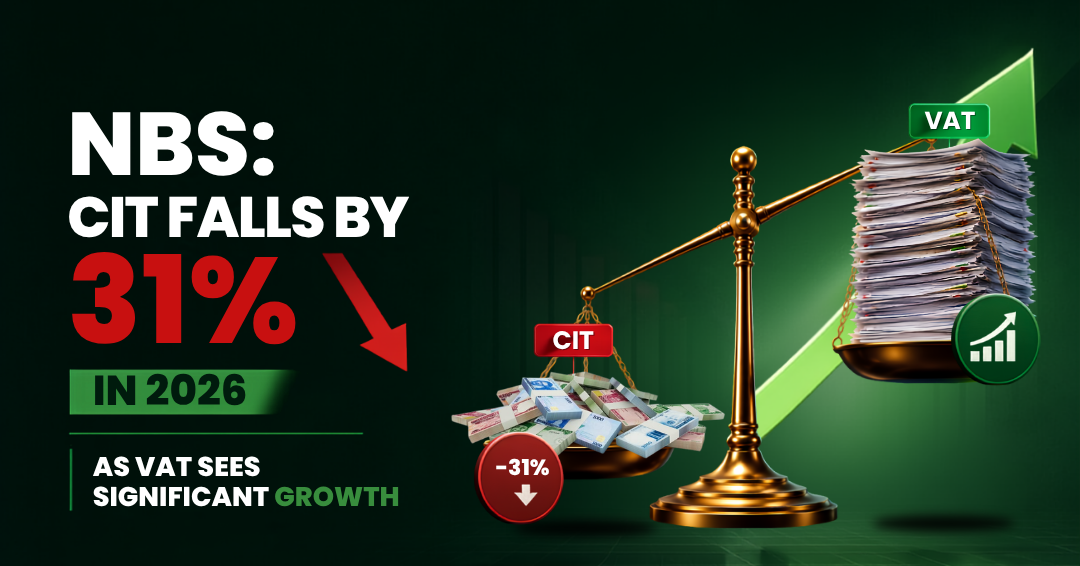
The National Bureau of Statistics has reported that Company Income Tax receipts fell by 31% year-on-year during the first quarter of 2026. According to the official Q1 2026 CIT Report released in Abuja, corporate tax collections declined from N1.98 trillion in the corresponding period of the previous year to N1.37 trillion.
Analysts link the decline to a difficult domestic operating environment. Local businesses are contending with elevated interest rates, unstable exchange rates and high energy costs, all of which are putting pressure on company profits.
The contrast with consumption tax performance makes the trend more striking. Opeyemi Ajetunmobi, Head of Advisory and Research at a Lagos-based investment firm, noted that Value-Added Tax collections for Q1 2026 increased by 17.06%, rising from N2.06 trillion to N2.42 trillion.
Ajetunmobi observed that these opposing results suggest that while general economic activity and consumer spending remain largely active across the country, companies are finding it extremely difficult to convert that transaction volume into actual profit amid unstable economic indicators.
Bolanle Daniel Utere, a Finance Director at a Free Trade Zone, reinforced this assessment, indicating that the fall in CIT revenue is the mathematical outcome of eroded company profits rather than a lifeless economy. Utere stressed that persistent inflationary pressure and rising operational costs are compressing profit margins, leaving businesses in a high-turnover, low-profit situation that ultimately reduces vital corporate tax inflows to the federal federation account.