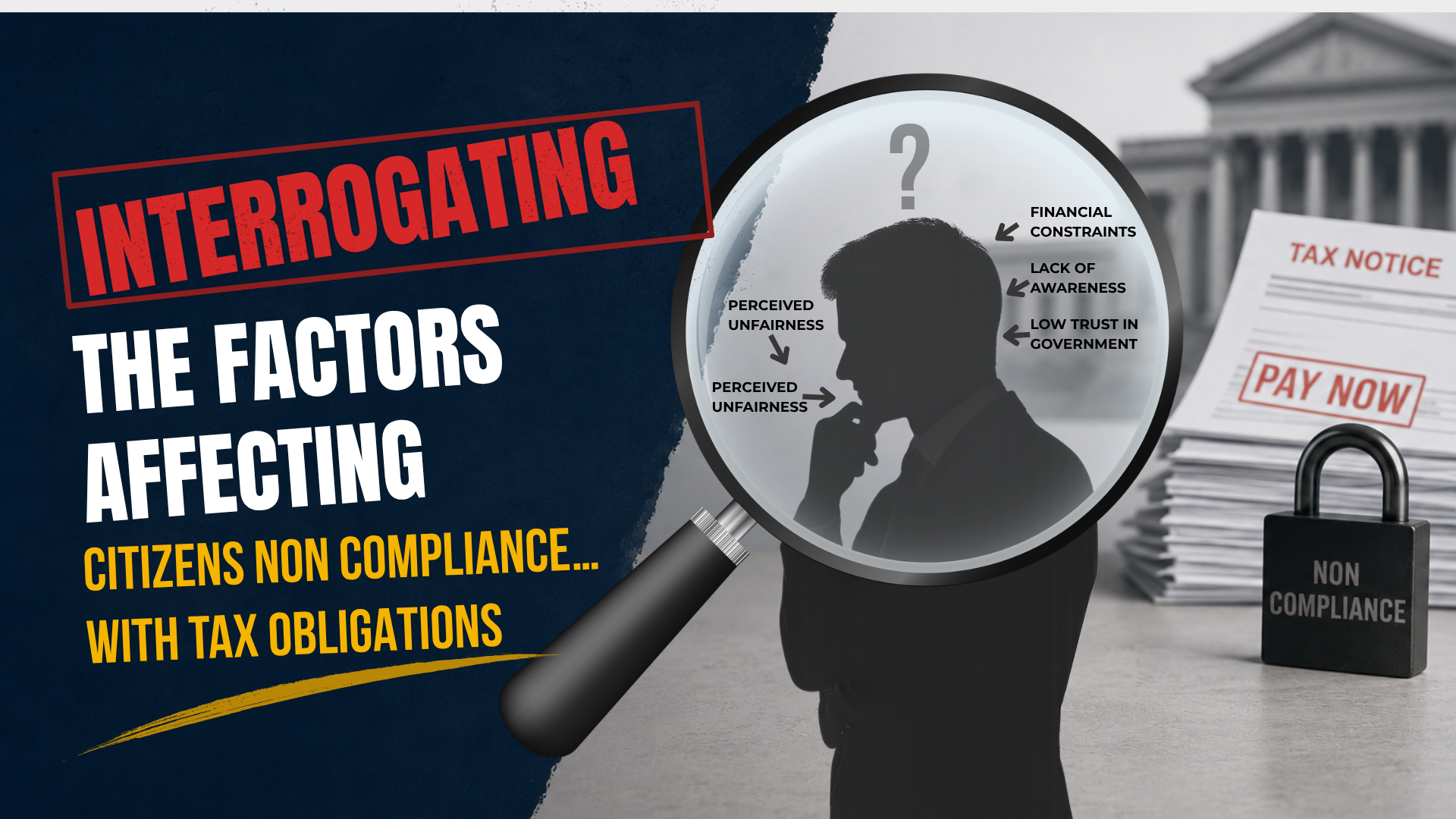
Nigeria's revenue challenge extends beyond legal frameworks into behavioural, informational and governance territory. The country's tax-to-GDP ratio stood at 8.2% in 2023, significantly below the African average of 16.1%, reflecting a persistent difficulty in converting economic activity into broad-based tax compliance. While the Nigeria Tax Act, 2025 and the Nigeria Tax Administration Act, 2025 were enacted to simplify and modernise the system, evidence indicates that compliance hinges not solely on legislation but on whether citizens understand the system, trust it and perceive tangible value in return.
Low awareness and weak taxpayer knowledge remain fundamental obstacles. Afrobarometer data show that 54% of Africans find it difficult to determine what taxes or fees they are supposed to pay, and research links such information gaps to weaker compliance attitudes. A 2023 study on personal income tax compliance in Nigeria identified lack of information, corruption and ineffective administration as key drivers of non-compliance. Separately, research on the informal sector in Ekiti State found that greater tax awareness significantly reduces tax evasion. Many citizens do not clearly understand what they owe, why they owe it or how to pay correctly.
The structure of Nigeria's labour market compounds the problem. The National Bureau of Statistics reported that 92.7% of employment was informal in the first quarter of 2024. Tax systems function best where incomes are visible, payrolls are structured, records are maintained and employer withholding mechanisms exist. Yet millions of Nigerians earn livelihoods as traders, artisans, transporters, freelancers, landlords and small service providers with irregular income and weak record-keeping. In this setting, non-compliance is often less about defiance and more about administrative invisibility, low tax identity and the absence of simple compliance pathways for those outside formal employment.
Distrust in government further erodes willingness to pay. Tax compliance strengthens where taxpayers believe revenue serves public purposes rather than private gain, but Nigerian survey evidence points to a weak fiscal social contract. Only 22% of Nigerian respondents told Afrobarometer they believed local government revenues were used for public services rather than private gain. Broader evidence across Africa shows that low trust in tax authorities and high perceived corruption weaken support for compliance. Many citizens do not view taxation as a reciprocal civic exchange but as extraction in a context where roads, schools, health facilities, water systems and security remain inadequate.

A clear disconnection between taxation and public services deepens the problem. Afrobarometer notes that many Africans pay private or non-state providers for services the state would ordinarily deliver, and that this can depress compliance. The Nigerian experience fits this logic closely: households must privately secure electricity, water, security, transport, healthcare and even basic sanitation. When the state appears absent in everyday welfare provision, the perceived value of formal taxation declines, even among citizens who acknowledge tax as a civic duty in principle.
Multiplicity of taxes and administrative complexity represent one of the clearest design failures in the Nigerian system. The World Bank has long documented the presence of nuisance taxes and multiple collection points. The 2025 reform agenda explicitly seeks to reduce taxes to a single-digit number, eliminate nuisance taxes, merge duplicative levies and simplify administration. That reform choice effectively amounts to an official admission that complexity, duplication and overlapping demands across institutions have been genuine barriers to compliance. For the average citizen or microbusiness owner, a tax system that appears repetitive, fragmented and unpredictable is more likely to be perceived as harassment than as lawful public finance.
Even the compliance process itself can be too difficult for ordinary people. The 2025 reforms seek to digitalise filing, registration and record-keeping and to build a more unified tax administration framework. In theory, that should reduce friction. Yet reform commentaries acknowledge that smaller businesses and informal operators may face new compliance burdens arising from technology costs and limited digital literacy. The challenge is two-sided: the old system was too fragmented and opaque, while the new system may remain too technical for low-capacity taxpayers unless onboarding, education and assisted filing are taken seriously. Digital does not automatically mean easy.
Economic hardship also pushes compliance down even when citizens know they should pay. Nigeria's macroeconomic conditions have been punishing for households. The IMF reported that inflation fell to 23.7% year-on-year in April 2025, down from the 2024 average but still very high. The World Bank reported that in 2024, labour incomes did not keep pace with inflation, pushing more Nigerians into poverty, with roughly 46% of the population living below the international poverty line. Under these conditions, tax compliance competes directly with food, rent, transport, school fees and survival spending. For many low- and middle-income Nigerians, delayed or avoided tax payment is often a liquidity response before it becomes a legal one.
Some citizens avoid tax to play safe. When people believe that entering the tax net may expose them to arbitrary assessments, repeated demands, enforcement agents, retroactive liabilities or payments they do not fully understand, many choose strategic invisibility. This is especially likely in informal sectors where income records are weak and multiple actors may claim authority. The issue is not only unwillingness to pay but fear of entering a system perceived as difficult to navigate and difficult to trust.
Nigeria's tax problem should therefore be framed not merely as a revenue shortfall but as a challenge of information, trust, administrative design and state legitimacy. If compliance is to improve, government must do more than demand payment. It must reduce duplication, improve taxpayer education, simplify filing and payment, protect citizens from arbitrary collection practices and make the use of tax revenue more visible in everyday public services. Until citizens can clearly answer three basic questions — what exactly do I owe, how do I pay it, and what public value comes back to me — non-compliance will remain a structural feature of the system rather than merely a moral failure of taxpayers.
